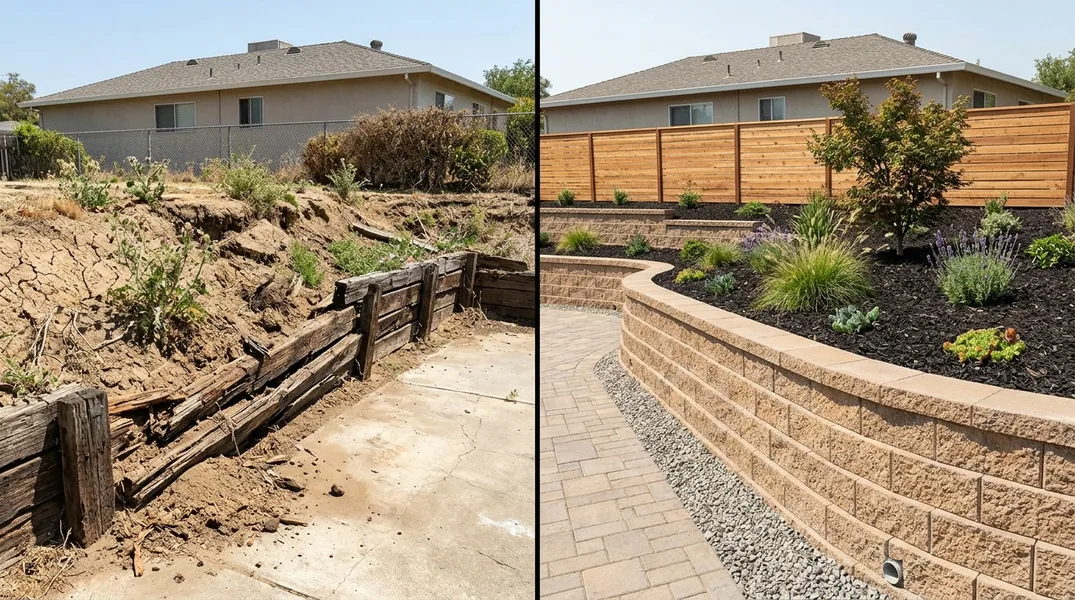
Why Stockton's Wet Winters Are Hard on Retaining Walls
Stockton's climate is often described as Mediterranean, with dry summers and a rainy season that typically runs from November through March. That seasonal swing is exactly what makes proper retaining wall drainage so important here. During the wet months, the soil behind a wall can become saturated, and water that has nowhere to go will find its way into the wall structure itself. Homeowners in Stockton often notice the consequences after a series of storms: leaning walls, cracked concrete, or soil washing out from around the base.
The problem is not just the total rainfall. It is the way water accumulates behind a wall when the soil is clay-heavy or when the original builder skipped a drainage layer. Once that water builds up, it creates pressure that the wall was never designed to resist. Understanding this cycle is the first step toward protecting your property, and it is why we emphasize drainage in every Retaining Wall Installation project we take on.
Hydrostatic Pressure: The Silent Force Behind Wall Failure
When water saturates the soil behind a retaining wall, it does not simply drain away on its own. The trapped water exerts what engineers call hydrostatic pressure retaining wall forces, which push outward against the back of the wall. A wall that was built to hold back dry soil may suddenly be asked to hold back a heavy, waterlogged mass. Over time, that extra load can cause the wall to bow, tilt, or even collapse. In many cases, the damage starts invisibly, with small cracks or movement that the homeowner does not notice until it is advanced.
Hydrostatic pressure is especially dangerous because it is cyclical. Each winter adds stress, and each dry summer offers only partial relief. Walls that survive one wet season may fail in the next. This is why we recommend that any wall showing signs of movement be evaluated promptly. Our Retaining Wall Repair service often begins with relieving that pressure before any structural fixes are made. Without addressing the water, repairs tend to be temporary.
How a Retaining Wall French Drain Protects Your Investment
The most reliable defense against hydrostatic pressure is a properly designed retaining wall french drain. This system typically consists of a perforated pipe placed in a gravel trench behind the base of the wall, wrapped in filter fabric to keep soil out, and connected to a discharge point away from the structure. When installed correctly, it intercepts groundwater before it can build up and directs it safely away. It is a simple concept, but the details matter enormously, including pipe slope, gravel gradation, and outlet placement.
Many older walls in Lodi and throughout the region were built without any drainage at all, or with weep holes that clog within a season or two. If your wall has no visible drainage system, or if water pools behind it after storms, a french drain retrofit is often the single most cost-effective improvement you can make. During a free estimate, we can assess whether your existing wall can be retrofitted or whether a more comprehensive solution is needed.
Warning Signs of Drainage Failure You Should Not Ignore
Drainage failure rarely announces itself with a dramatic collapse. Instead, it shows up as a series of smaller clues: water pooling at the base of the wall, soil eroding from between blocks, white mineral stains on the face of the wall, or a slight lean that seems to worsen each year. You may also notice that the ground behind the wall stays soggy long after the rain stops. Any of these signs warrant a closer look, especially if your wall is more than ten years old or was built before modern drainage standards became common.
Ignoring these warnings is expensive. A wall that could have been saved with a drainage retrofit may eventually require full Retaining Wall Replacement. In the worst cases, a failing wall can damage landscaping, driveways, or nearby structures. If you are unsure whether your wall is at risk, a professional inspection is the safest path. We serve homeowners in Manteca and Tracy as well, and we see the same drainage-related patterns across the region.
Retaining Wall Drainage Near Me: When to Call a Professional
Some homeowners consider adding a french drain themselves, and for a small garden wall, that may be reasonable. But retaining walls are structural systems, and the drainage design has to match the wall's height, the soil type, and the site's grading. A drain that is undersized, improperly sloped, or routed to the wrong outlet can make the problem worse by concentrating water in one area. This is particularly true on sloped lots, which are common in parts of Stockton.
If you are searching for retaining wall drainage help near me, look for a contractor who treats drainage as part of the structural design rather than an afterthought. Concrete Retaining Walls and other heavy systems require especially careful water management because they cannot flex the way timber or modular block walls can. A professional assessment will tell you whether your wall needs a simple retrofit, a repair, or a full rebuild. Call Stockton Retaining Wall at (209) 290-1372 to schedule a free estimate and get a clear plan before the next rainy season arrives.
Looking for a professional retaining wall contractor in Stockton? Stockton Retaining Wall responds fast for all your retaining wall needs.
Get a Free QuoteOur services: Retaining Wall Installation · Retaining Wall Repair · Retaining Wall Replacement