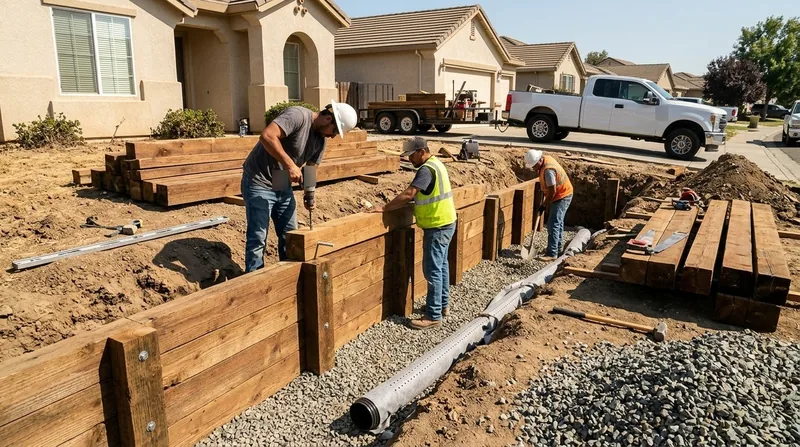




Timber Retaining Walls in Stockton
Stockton sits on the flat eastern edge of the Sacramento-San Joaquin Delta, where the Calaveras River, the deep-water channel, and a web of sloughs cut through dense adobe clay and peat over a high water table. That ground swells hard in winter rains and shrinks back in the dry summer heat, which is why so many older timber and railroad tie walls around the Magnolia district and the Miracle Mile have started to lean, bow, or rot at the base. If you are looking for Timber Retaining Walls in Stockton, we build pressure-treated timber walls for garden beds, low terraces, and budget-minded grade changes, and we tell you straight when timber is the right call and when a longer-lasting material makes more sense. For waterfront lots in Brookside and Spanos Park, or cottages in Country Club, the goal is the same: a wall that holds its line through the wet season and stays put through the dry one. You can see how this fits our broader retaining wall installation work across the city.
Why Timber Walls Still Make Sense on Stockton's Flat, Heavy Clay Lots
Most Stockton lots are level, so walls are low: raised garden beds, planter borders, pool-deck grade changes, and the occasional tired railroad tie border behind a 1950s ranch. Timber handles those short heights well and costs far less than block or poured concrete. The catch is our soil. Dense adobe clay and peat hold water against the wood, and the high water table keeps the base damp, so untreated or poorly drained timber rots from the bottom up.
- We set every timber wall on a compacted gravel base so the clay cannot pump water into the wood.
- We use pressure-treated lumber rated for ground contact, not fence-grade boards.
- We build in a drainage layer and weep points so winter rain escapes instead of pushing the wall out.
- We keep timber walls at low heights, because tall timber in swelling clay is a losing bet.
Done that way, a timber wall gives you a clean, affordable edge for years, and you know exactly what you are getting.
Key info: A waterfront lot off the Calaveras River in Stockton can sit on peat that stays wet year-round. Timber there needs a gravel base and real drainage, or it will rot at the soil line within a few seasons. We check the soil before we quote.
Before you build, check the City of Stockton's building permit guidance at stocktonca.gov, since wall height and surcharge rules decide whether you need a permit.
How We Build a Timber Wall That Survives Stockton's Wet and Dry Cycles
We start by reading the ground, not the sketch. On a level Stockton lot the wall is usually short, but the clay and water table decide the base depth and the drainage detail. We dig to firm soil, set a gravel footing, and build the timbers level and dead straight so the wall does not creep. Then we backfill with drain rock and tie the courses back into the slope.
- We walk the site and check soil, slope, and where water runs during winter rain.
- We set string lines and dig a trench to firm ground, deeper on peat or soft fill.
- We compact a gravel base and lay the first course level, because everything above it follows.
- We stack pressure-treated timbers, spike or pin each course, and keep the face plumb.
- We install drain rock, filter fabric, and weep points behind the wall.
- We backfill in lifts and compact, then clean up and haul off the spoil.
That sequence is what keeps a low timber wall from bowing out after the first wet winter.
Key info: A homeowner in Lathrop had a 2-foot timber bed wall that heaved every January. We rebuilt it on gravel with a drain layer and filter fabric, and it has held its line through two wet seasons. Same lumber, better base and drainage.
If your existing wall is already leaning or bulging, that is a repair job, not a new build. See our leaning and collapsed wall repair service, and read up on retaining wall drainage if water is the culprit.
Timber Wall Approaches We Use Around Stockton
Not every timber job is the same. A raised garden bed in Weston Ranch and a slough-bank wall on a waterfront lot need different details. Here is how we match the approach to the site.
| Approach | Description | Best for |
|---|---|---|
| Low timber bed wall | Pressure-treated timbers on a gravel base, 1 to 2 feet high. | Raised garden beds and planter borders on level lots. |
| Terraced timber wall | Two or three short courses stepped back into the slope. | Yards with a gentle grade change and tight budget. |
| Timber with drainage layer | Drain rock, filter fabric, and weep points behind the wall. | Clay and peat soils, waterfront lots, wet winter sites. |
| Timber over railroad tie removal | Pull old creosote ties and rebuild in treated timber. | Tired tie borders behind older Stockton homes. |
We pick the approach after we see the soil and the water, not before.
Timber Retaining Walls Cost in Stockton: What to Expect
Timber is the budget-friendly option, and most Stockton jobs land in a range you can plan around. We quote from $20 per square foot as a starting point for a basic low timber wall. The final number moves with wall height, soil conditions, drainage needs, and access to the site.
- Wall height and length drive the lumber count and the labor hours.
- Peat or soft fill means deeper digging and more base gravel, which adds cost.
- Drainage layers and filter fabric add material but protect the wall for years.
- Tight access behind a Country Club cottage means hand digging and slower work.
- Removing an old railroad tie wall adds disposal and haul-off.
Get two or three estimates so you can compare scope, not just the bottom line. Our full pricing overview breaks down the details.
Timber Retaining Walls Near Me: Hiring a Contractor Near Stockton
Ask three things before you sign: license, insurance, and references from jobs like yours. A timber wall is only as good as its base and drainage, so ask how the contractor handles Stockton's clay and high water table. Ask whether a permit is needed for your wall height and surcharge, and check any HOA rules before work starts.
- Confirm the contractor is fully insured, and ask for a certificate.
- Get at least two or three written estimates with the same scope.
- Ask for references from Stockton, Lodi, or Manteca jobs you can call.
- Check permit thresholds with the local building department before you build.
Good contractors welcome those questions, because they know the base and drainage are what keep a timber wall standing.
Ready to talk through your project? Reach out through our contact page and we will set up a free estimate.
Timber Retaining Walls in Stockton: Pricing Guide
| Service | Price | Details |
|---|---|---|
| Low timber bed wall | Starting at $20/sq ft | Pressure-treated timbers on gravel base, 1 to 2 feet high, includes cleanup and haul-off |
| Timber wall with drainage layer | Starting at $28/sq ft | Adds drain rock, filter fabric, and weep points for clay and high water table sites |
| Railroad tie removal and rebuild | Starting at $32/sq ft | Includes pulling old creosote ties, disposal, and rebuilding in treated timber |
| Complex or large-scale job | On estimate | Tiered walls, tight access, or peat soils need an on-site look before pricing |
| Travel | Included | In Stockton and surrounding areas, no separate call-out or mileage fee |
| Estimate | Free | Response within 24h at (209) 290-1372, no obligation to book |
Indicative pricing, the exact cost depends on square footage, finish, and site access. Free personalized estimate within 24h at (209) 290-1372.


