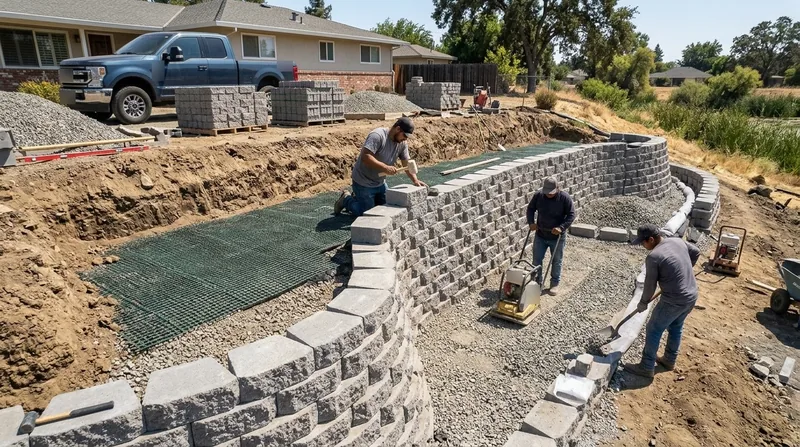




Block & Segmental Retaining Walls in Stockton
Stockton sits on the flat eastern edge of the Sacramento-San Joaquin Delta, where the Calaveras River and the deep-water channel cut through dense adobe clay and pockets of peat over a high water table. That ground swells hard in winter rains and shrinks through the dry summer, which is exactly why Block & Segmental Retaining Walls in Stockton need engineered reinforcement, not just stacked block. From the Victorians and Craftsman homes in the Magnolia district to the 1990s and 2000s tract and waterfront homes in Brookside, Spanos Park and Weston Ranch, most lots are level and the walls are low: CMU planters, raised beds, pool-deck grade changes and slough-bank walls. We build mortarless Allan Block, Versa-Lok and Keystone systems with geogrid tied back into stable soil, so the wall moves with the clay instead of fighting it. If you are comparing options, start with our retaining wall installation page and then call us for a site walk.
Why Segmental Block Walls Fail on Stockton's Adobe Clay and Peat
Stockton's soil is the whole story here. The dense adobe clay and peat layers hold water in winter and shrink in the dry summer, and a wall built without drainage or geogrid gets pushed out by hydrostatic pressure long before the block itself fails. That is why the failure we see most in this city is not a cracked block, it is a wall that leans or bulges because the base was never pinned into stable soil.
- We see bulging and leaning walls on older Miracle Mile and Country Club lots where 1920s to 1950s cottages had raised beds built with no gravel drain.
- Waterfront lots in Brookside and Weston Ranch deal with slough-bank saturation and a high water table that softens the footing zone.
- Winter rains load the clay, the wall pushes out, and the damage shows up by February in most years.
- Dry summer shrinkage opens cracks in the footing and lets the block settle unevenly.
- Older railroad tie borders along property lines rot and collapse, and block is the usual upgrade.
When a wall is already leaning, we treat it as a repair priority and assess whether the block can be salvaged or needs replacement.
Key info: A raised bed on a Country Club lot built with block and no drain rock will typically lean within two wet seasons. We rebuild the base with compacted gravel and a perforated drain before we set the first course.
Local rules matter too. Many jurisdictions require a permit for walls above roughly 4 feet measured from the footing, or when the wall supports a surcharge such as a driveway or structure, and engineered drawings may be needed for tall or tiered walls. Verify thresholds with the City of Stockton building department before you build: City of Stockton official site.
How We Build a Segmental Block Wall in Stockton, Step by Step
We do not set block on native clay and hope. Every wall starts with an excavation to stable soil, a compacted gravel base, and a drainage plane behind the block. Then we pin the courses with geogrid at the engineered spacing, which is what keeps a low garden wall and a tiered terrace wall behaving the same way through a wet winter.
- We walk the site and check soil, slope, drainage and the property line before we quote.
- We excavate to stable material and compact a gravel base to the required depth.
- We set the first course dead level, because every course above it inherits that line.
- We install perforated drain pipe and gravel behind the block, then backfill in lifts.
- We lay geogrid at the engineered spacing and tie it back into the retained soil.
- We cap the wall, compact the backfill, and clean the site before we leave.
If your wall ties into a slope or a drainage problem, we bring in the retaining wall drainage scope so the water has somewhere to go.
Key info: On a Lathrop backyard terrace we rebuilt last spring, the original block sat on bare clay with no drain. We pulled the block, cut in a gravel base, added drain pipe and two courses of geogrid, and the wall has held through two rain seasons.
Block and Segmental Wall Approaches We Use
Not every wall needs the same system. We match the block, the reinforcement and the base detail to the load, the soil and how the wall will be used, whether it is a planter in the Magnolia district or a slough-bank wall in Brookside.
| Approach | Description | Best for |
|---|---|---|
| Allan Block | Mortarless pinned block with geogrid options and a clean split-face look. | Curved planters and backyard terraces on level Stockton lots. |
| Versa-Lok | Solid, heavy block with a pin system and strong overturning resistance. | Taller walls and slough-bank walls carrying soil and surcharge. |
| Keystone | Fiberglass-pin system with geogrid, widely used on engineered walls. | Tiered walls and raised beds that need a stamped design. |
| CMU block with drainage | Concrete block planter with gravel backfill and drain pipe. | Low garden walls and pool-deck grade changes. |
We pick the system after we see the soil and the load, not before.
Block & Segmental Retaining Walls Cost in Stockton: What to Expect
Most segmental block walls in Stockton start around From $25 per square foot of wall face, and that figure covers block, base, drain rock and standard geogrid. The number climbs with height, with how tight the access is, and with how much excavation the clay and peat demand. A low planter in Weston Ranch is a different job than a slough-bank wall in Brookside that needs deeper base work and heavier reinforcement.
Access is the biggest swing factor. A backyard wall you can reach with a skid steer prices very differently from one behind a 1920s cottage in the Miracle Mile where every pallet comes through a side gate by hand. Soil type matters too: peat over a high water table means over-excavation and more gravel, and that adds cost. Surcharge loads, like a driveway or a structure above the wall, push the design toward engineering and heavier geogrid.
Get two or three written estimates on the same scope and compare what is actually included, especially base depth and drainage. Our full pricing overview breaks down the line items so you can read each bid against the same checklist.
Hiring a Block & Segmental Retaining Wall Contractor Near Me in Stockton
Ask how the contractor handles drainage and geogrid, because a bid that skips either one is a bid for a wall that will lean. Ask for local references on walls at least two winters old, since that is when clay movement shows up.
Confirm who pulls the permit if your wall is above the local threshold or carries a surcharge, and get the answer in writing. If you are in an HOA community in Brookside or Spanos Park, check the architectural rules on block color and wall height before you order material. A contractor who has built in Stockton will already know to ask.
Reach out through our contact page and we will schedule a site walk at no cost.
Block & Segmental Retaining Walls in Stockton: Pricing Guide
| Service | Price | Details |
|---|---|---|
| Low garden wall or raised bed (under 3 ft) | Starting at $25/sq ft | Includes block, compacted gravel base, drain rock and cap; height and access move the price. |
| Engineered wall with geogrid (3 to 4 ft) | Starting at $38/sq ft | Includes geogrid reinforcement, perforated drain and engineered spacing; soil and surcharge move it. |
| Waterfront or slough-bank wall | On estimate | High water table and peat demand over-excavation and heavier block, so we price after a site walk. |
| Wall removal and block replacement | On estimate | Tear-out, haul-off and base rebuild vary with access and how much of the old wall can be salvaged. |
| Travel | Included | In Stockton and surrounding areas, no separate call-out or mileage fee. |
| Estimate | Free | Response within 24h at (209) 290-1372, no obligation to book. |
Indicative pricing, the exact cost depends on square footage, finish, and site access. Free personalized estimate within 24h at (209) 290-1372.


